
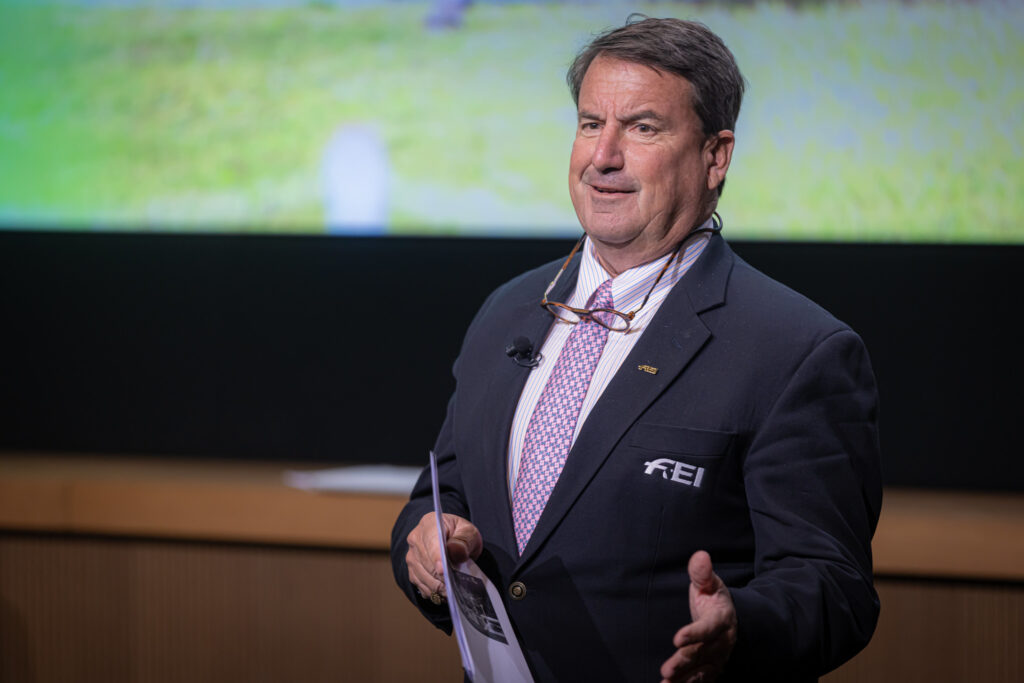
From evidence to application: Data takes centre stage in FEI welfare Strategy
The closing session of the FEI Sports Forum in Lausanne—Data Driven Welfare and Safety—brought together four speakers approaching the same question from different angles: how data can move equestrian sport from reactive regulation to informed, measurable decision-making.
Across the session, a consistent theme emerged. Data is no longer simply used to analyse what has happened—it is increasingly shaping how the sport operates, how risks are managed, and how welfare is communicated both internally and externally.
Influencing behaviour, not just writing rules
Opening the session, FEI Veterinary & Welfare Director Göran Åkerström set the tone by challenging a long-standing assumption.
“Is regulation always the best solution? I’ve learned in recent years that it’s actually not.”
Instead, he described a broader approach where data supports not only rules, but behavioural change.
His examples reflected different stages of that process. In endurance, the hypersensitivity control system has contributed to a clear reduction in catastrophic injuries—an example of targeted intervention based on data. In contrast, oral health controls remain in a monitoring and education phase, with the FEI deliberately choosing to build evidence before introducing regulation.
Research into footing has reached a scale that allows for increasingly precise conclusions. With tens of millions of data points collected, the FEI is now able to analyse how surface composition influences load on limbs, moving towards guidance that can be adapted to conditions rather than imposed as fixed standards.
It was, however, his example from the Swedish trotting sector that provided the clearest illustration of how data can reshape an entire sport.
Through the Trotter Health Project, long-term data collection has been used to identify patterns in injuries, equipment-related incidents and training practices. This has led to concrete changes—improvements in tack safety, stable ventilation and trainer behaviour—and a rapid reduction in certain types of accidents once the findings were fed back into the system.
Just as importantly, the data created transparency. Authorities were given full access, which in turn reduced pressure for external legislation, while the sport itself gained a powerful tool to respond to criticism.
“You can be proactive, but you can also defend yourself reactively. This is reality. This is what we have.”

When data changes rules—and improves outcomes
Professor Tim Parkin followed with a detailed look at how data moves from analysis into policy.
Drawing on his work with the FEI and across racing jurisdictions, he showed how large-scale datasets have already led to measurable improvements—particularly in endurance.
The Global Endurance Injuries Study (GEIS) revealed that risk is multi-factorial, with speed only one element among many. One of the most significant outcomes was the refinement of mandatory rest periods.
Rather than applying uniform rest requirements, the FEI introduced more targeted rules based on risk profiles. The effect has been clear: extending and tailoring recovery periods has reduced both injuries and failures to qualify, demonstrating how relatively small regulatory adjustments can have a measurable welfare impact.
“It was pivotal to be able to say: we’ve got the data, and this is what will happen if we change the rule.”
Beyond FEI sport, Parkin pointed to the Equine Injury Database in North America as one of the most impactful welfare initiatives in racing. Over time, systematic data collection has contributed to a substantial decline in fatal injuries, while also shifting attitudes within the industry towards a more welfare-driven approach.
He also highlighted the move towards predictive modelling. In Hong Kong, risk profiling is now used ahead of races to flag horses at higher risk of injury, supporting veterinary decisions before issues develop.
“If the vet is unsure, and the data is also telling them something, then they may make a different decision.”
At the same time, Parkin stressed the limits of current systems. The challenge is no longer the volume of data, but its depth—particularly the lack of consistent veterinary and training records.
Rising competition intensity and its impact on longevity
The third presentation, from PhD researcher Harry Stone, turned to jumping horses and the long-term effects of workload and management.
Developed in collaboration with the FEI since 2019, the project has expanded beyond competition intensity to include transport, early career activity and overall career trajectories.
One of the clearer indicators of change is the increase in travel demands. Between 2014 and 2024, the median distance travelled by FEI jumping horses has risen, reflecting a more international competition structure and increased movement between events.
This growing transport load adds to cumulative intensity—an element that is not always visible in competition data, but which may influence both performance and longevity.
More broadly, the findings point towards a combination of factors shaping careers: early exposure to higher levels, sustained competition intensity and management practices over time.
Stone also involved the audience directly. Through live polling, delegates identified injury, competition intensity and management as the most significant factors influencing career length, with early career activity and rider influence also ranking highly.
At the same time, important variables—such as conformation and full veterinary histories—remain difficult to capture within current datasets, limiting how far predictive analysis can go.
Where data reshapes the sport
The final presentation, from FEI Vice President and Eventing Committee Chair David O’Connor, brought the discussion firmly into the practical reality of the sport.
A three-time Olympic medallist, O’Connor presented the FEI Eventing Risk Management Programme as a system that is actively shaping outcomes—not just analysing them.
The overall trend shows a continued decrease in falls, but he was clear that this is the result of sustained, data-driven work over time. One key factor has been the introduction and refinement of Minimum Eligibility Requirements (MERs), which have helped ensure that combinations reach the appropriate level of experience before stepping up. This, he suggested, has played a significant role in reducing risk across the sport.
At the same time, he cautioned against focusing too narrowly on the top level.
“We spend a lot of time talking about four- and five-star competitions—but where are our clients? They’re in the two- and three-star classes.”
The point was a practical one. The majority of riders—and therefore the majority of risk exposure—sits below the very top tier. Data collection and risk management must therefore reflect the whole sport, not just its most visible level.
The FEI now gathers detailed data on cross-country performance, including individual fences, course design, rider decisions and outcomes. This information is fed back directly to course designers, creating a continuous feedback loop.
“We’re not guessing anymore. We actually know where the problems are.”
Course designers receive data linked to specific fences, allowing them to see how horses interact with particular questions. Over time, this has led to measurable refinements.
Fence types such as the Trakehner have been closely analysed. The findings suggest that risk is rarely inherent in the obstacle itself, but depends on how it is presented—approach, terrain and rider decisions all playing a role.
An exchange with a spectator from the floor reinforced that point, focusing on how execution influences outcome. O’Connor’s response made clear that the aim is not to remove traditional elements, but to refine them through evidence.
The programme also introduces a new level of feedback and accountability, with data linked to individual course designers.
“This is about learning. It’s not about blaming—it’s about getting better.”
He returned, finally, to the importance of communication.
“The numbers are the numbers. How the story is told is the most important element.”

A shared direction—and a final note
The session closed with a short intervention from Malin Axel-Nilsson of the FEI Equine Welfare Group, who highlighted how the work presented aligns closely with the FEI’s broader welfare strategy and ongoing efforts to mitigate risk for both horses and riders.
Taken together, the session reflected a sport moving towards a more evidence-based model—one where welfare is increasingly defined, measured and defended through data.
From Åkerström’s behavioural approach, through Parkin’s rule changes, Stone’s emerging research and O’Connor’s practical application, the direction is clear.
Data is no longer supplementary. It is becoming central to how the sport understands itself—and how it showcases to others.
Relevant links to official documents and pages:
Summary from FEI
Presentation Data driven welfare and safety
Panellists biographies
Youtube video Session 8 Data driven welfare and safety [starts 2:32 into the segment], the first half is session 6 Para-dressage rules and session 7 FEI Stable Manager