

FEI Veterinary Regulations Revision Puts Welfare, Science and Practical Reality Under the Spotlight
The full revision of the FEI Veterinary Regulations, presented at the FEI Sports Forum in Lausanne, marked the first comprehensive overhaul of the rules since the recommendations of the Equine Ethics and Well-being Commission. Framed as both a technical and philosophical exercise, the session revealed a governing body attempting to align scientific knowledge, welfare expectations and the realities of elite sport—while leaving several of the most sensitive questions deliberately open for consultation.
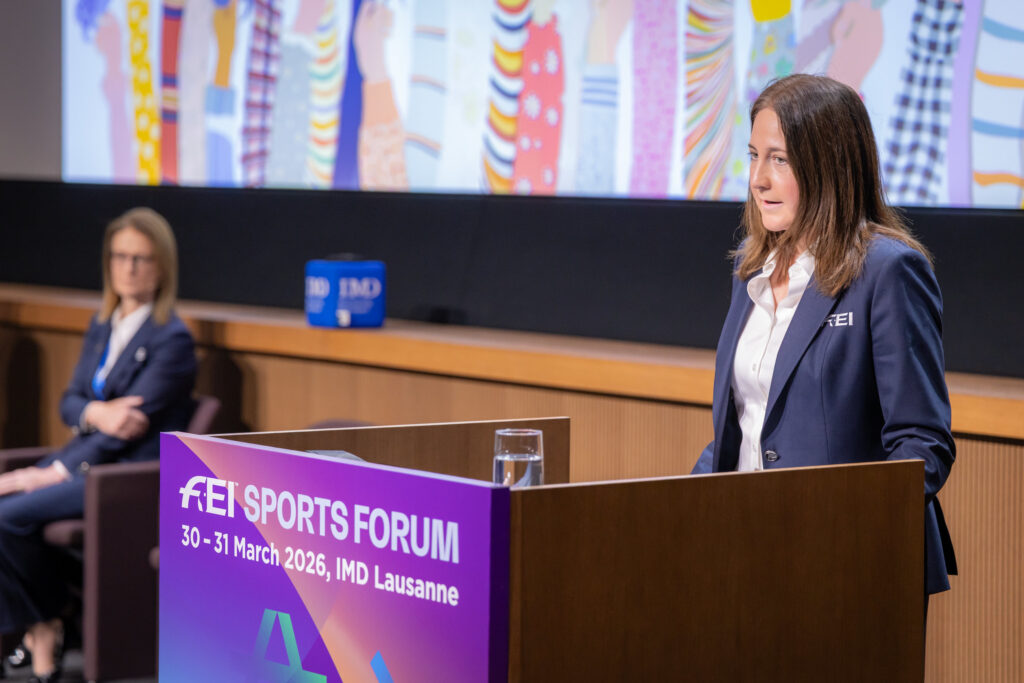
Opening the session, Veterinary Committee Chair Jennifer Hall underlined that the revision is rooted in a “constant endeavour to protect equine health and welfare,” while also ensuring that the sport does not face a repeat of crises such as the 2021 EHV outbreak. The work reflects not only regulatory necessity but also the broader shift initiated by the FEI Welfare Strategy.

Senior Veterinary Advisor Caterina Termine outlined a structured revision process built on a line-by-line reassessment of the rules, guided by principles including scientific evidence, welfare impact, enforceability and public perception. At its core lies a recurring question: whether each rule remains fit for purpose—or whether some issues are better addressed through education rather than regulation.
From physical soundness to “fitness to compete”
At the centre of the proposed changes is the introduction of a clearer, overarching concept of “fitness to compete”, extending beyond physical health to include behavioural and mental aspects.
“There is no general rule on fitness to compete, even if it is such an important concept,” said FEI Veterinary & Welfare Director Göran Åkerström. The proposal would introduce a dedicated article supported by a behaviour assessment protocol and further research into equine mental state.
The inclusion of mental fitness immediately prompted debate. From the International Jumping Riders Club (IJRC), chairman François Mathy Jr and Eleonora Ottaviani both supported the importance of recognising the psychological dimension of equine athletes, while questioning how such a concept could be applied consistently in practice.
Mathy described the notion as difficult to translate into a rule-based environment, asking who would ultimately decide whether a horse is mentally fit to compete and warning that the concept risks becoming “very abstract”.
Ottaviani illustrated the complexity through a concrete example, referring to Diamant de Semilly—a stallion known during his sport career for being difficult to handle, yet who went on to become one of the most influential sires in modern showjumping. Her intervention highlighted the grey area between challenging behaviour and top-level performance.
Hall acknowledged the challenge, noting that where earlier generations relied on implicit horsemanship, modern sport requires clearer definitions: “We need to be able to show it and spell it out.”
Åkerström stressed that the intention is not abstraction but progression, linking the concept to science and education: improved understanding of behaviour should lead to better management and, ultimately, fewer welfare issues.
Stronger stance on welfare risks and grey areas
Several proposals aim to address areas where current rules are either unclear or insufficient.
Among them is a renewed attempt to regulate neurectomy, with the FEI considering either a full prohibition or a targeted ban on specific procedures. The discussion indicated support for clearer rules, particularly from federations and veterinarians facing pressure in ambiguous situations.
Other proposals include the introduction of body condition scoring using the Henneke scale and a requirement for at least one functional jugular vein in endurance horses—both framed as practical tools to support objective welfare decisions.
Medication, injections and the question of necessity
The most animated part of the session centred on medication and supportive treatments.
The possible introduction of therapeutic use exemptions for pergolide raised a fundamental ethical question: can a horse requiring ongoing medication still be considered fit to compete on equal terms?
More immediate debate surrounded proposals to restrict non-emergency injections and so-called “comfort treatments”. Åkerström pointed to cases where substances are administered without clear clinical justification, describing this as both a welfare concern and a matter of public perception.
The response from the floor exposed a clear divide. Riders and federations emphasised that supportive treatments can form part of responsible horse management, particularly in demanding disciplines or extreme climates. A young rider highlighted the need to consider geographical context, pointing to competitions held in extreme heat.

Another intervention framed the issue in terms of perception: if the sport is trying to demonstrate good welfare, how can it justify removing treatments intended to support the horse?
Åkerström responded by drawing a clear line between necessary veterinary care and routine intervention. The issue, he said, is not treatment itself but its use without proper diagnosis.
Hall summarised the dilemma more starkly, questioning whether reliance on such treatments might indicate that the demands of competition have exceeded what should reasonably be expected of the horse.
Safety, behaviour and the limits of tolerance
The proposal to introduce clearer rules around dangerous horses brought one of the more grounded and experience-based interventions of the session.
Åkerström pointed to real incidents from FEI events, describing situations where horses had attacked other horses or posed risks to people, including cases where individuals had been injured. While such cases are rare, he stressed that they are serious enough to require clearer guidance.
The concern, he explained, is not limited to behaviour in competition, but also in everyday handling: horses that cannot be safely led, that require multiple handlers, or that present a risk during routine procedures such as inspections or equipment checks.
“If you have horses that repeatedly have these kinds of behaviours, I think it’s a quite serious matter,” he said, framing the proposal as a question of both welfare and human safety.
The IJRC contribution—reinforced by Ottaviani’s earlier example—highlighted the complexity of drawing a clear line. Some high-performance horses may be difficult or reactive, yet still manageable within experienced systems.
Åkerström acknowledged that the issue remains unresolved, presenting it explicitly as a point for consultation rather than a fixed rule proposal.
Control, enforcement and unintended consequences
Proposals to restrict the presence of certain medications on FEI venues—and the potential need for expanded enforcement powers—highlighted the practical difficulties of implementation.
At the same time, suggestions to introduce fines in areas such as stable management prompted caution from delegates, who warned against creating an “us against you” dynamic between regulators and participants.
Fluids debate sharpens welfare discussion
One of the clearest exchanges came around the use of intravenous fluids.
A young rider questioned whether tighter regulations would prevent necessary care after demanding efforts, particularly in eventing. Åkerström clarified that the intention is not to ban fluids, but to ensure they are administered based on veterinary assessment rather than routine practice.
Hall, however, brought the discussion back to first principles, suggesting that if such interventions are routinely required, it may be necessary to question the demands placed on the horse.
A framework still in formation
Throughout the session, the FEI emphasised that the proposals remain part of an ongoing consultation process. Many of the most consequential ideas—from mental fitness to medication rules—are still at a conceptual stage.
What emerged in Lausanne was not a finished rulebook, but a sport actively reassessing its boundaries—seeking to ground itself more firmly in science and welfare, while navigating the practical realities of elite competition.
Relevant links to official documents and pages:
Summary from FEI
Presentation Veterinary matters
Panellists biographies
Youtube video Session 4 Marketing and Communication Strategy, the second half is the section for Veterinary matters