
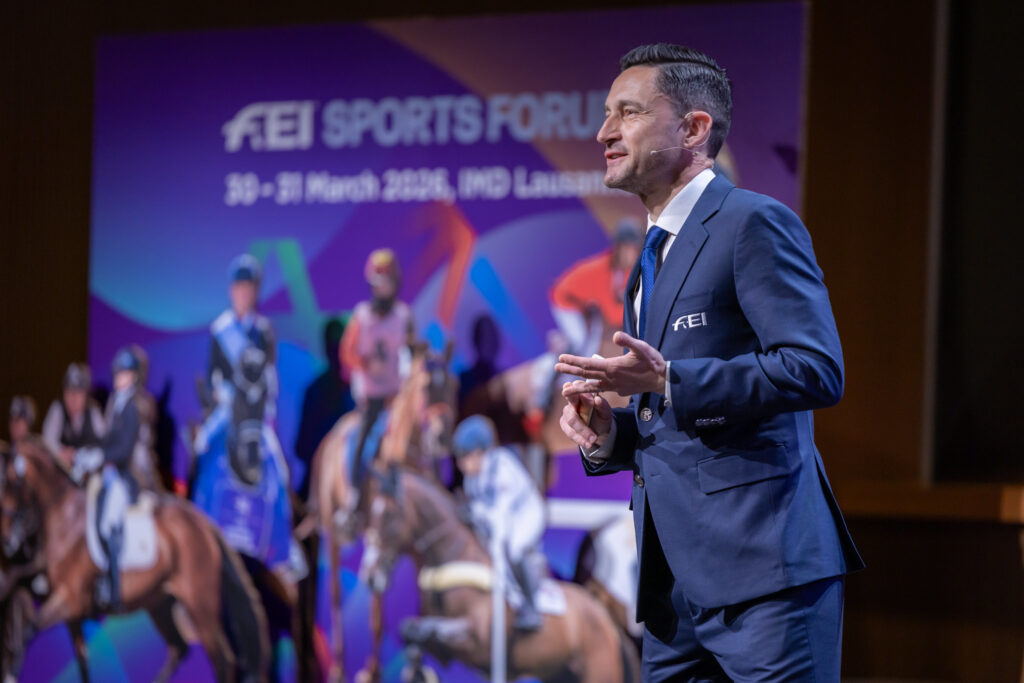
Communications, participating in his first FEI Sports Forum. © FEI/Germain Arias-Schreiber
FEI Sets Out Communication Strategy Towards 2030, Emphasising Audience Growth and Storytelling
The second day of the FEI Sports Forum in Lausanne opened with the presentation of the Federation’s proposed Marketing and Communication Strategy for 2026–2030, outlining a broad framework intended to guide how equestrian sport is presented to global audiences in the coming years.
Introduced as a “direction of travel” rather than a finalised plan, the strategy has been developed with input from external advisors, including the sports consultancy firm CAA Portas, as part of a process that combines internal review, stakeholder consultation and benchmarking against other international sports.
Opening the session, FEI Secretary General Sabrina Ibáñez highlighted the need to adapt to a rapidly evolving landscape in which expectations of transparency are increasing and the sport faces growing competition for attention. The aim, she said, is to communicate “more clearly, more consistently, and more effectively” across a complex global stakeholder base.
Presenting the strategy was director François Vergnol enrolled by the FEI in August 2025. He outlined four main priorities: showcasing the sport’s “unique excellence”, growing and better understanding its audience, positioning the FEI as a modern and trusted governing body, and strengthening public confidence in equestrian sport.
A central element of the approach is a stronger focus on storytelling, with increased emphasis on both equine and human athletes. Vergnol pointed to the need to develop clearer narratives and personalities within the sport, including competitive rivalries, as a way to engage wider audiences. “We must not be shy to find and amplify the main rivalries,” he said, noting that equestrian sport does not benefit from the club structures that drive engagement in many other disciplines.
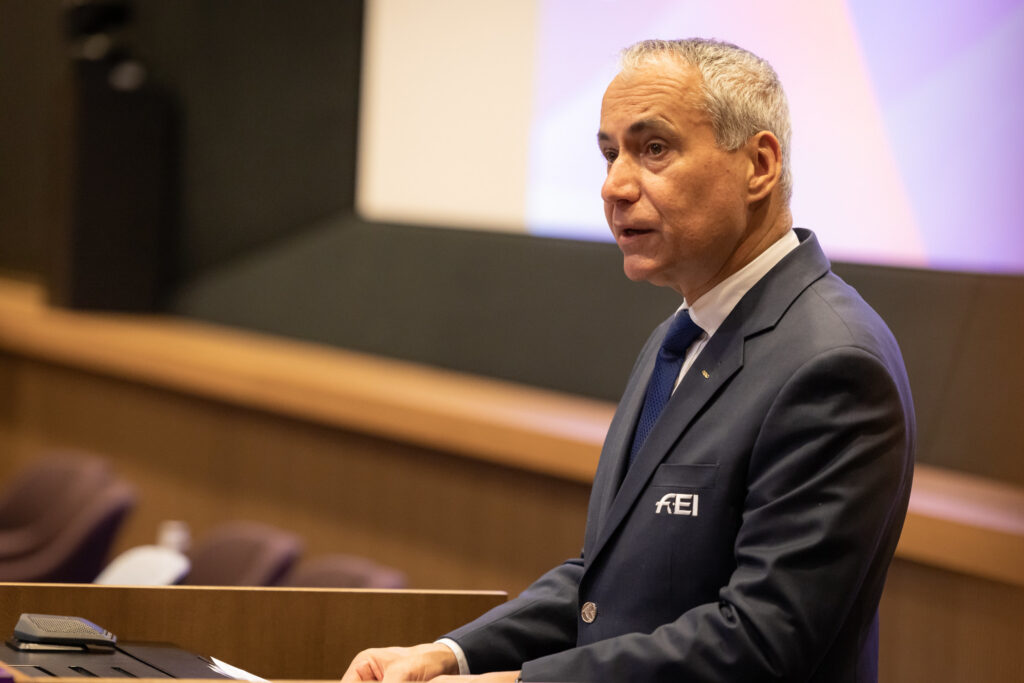
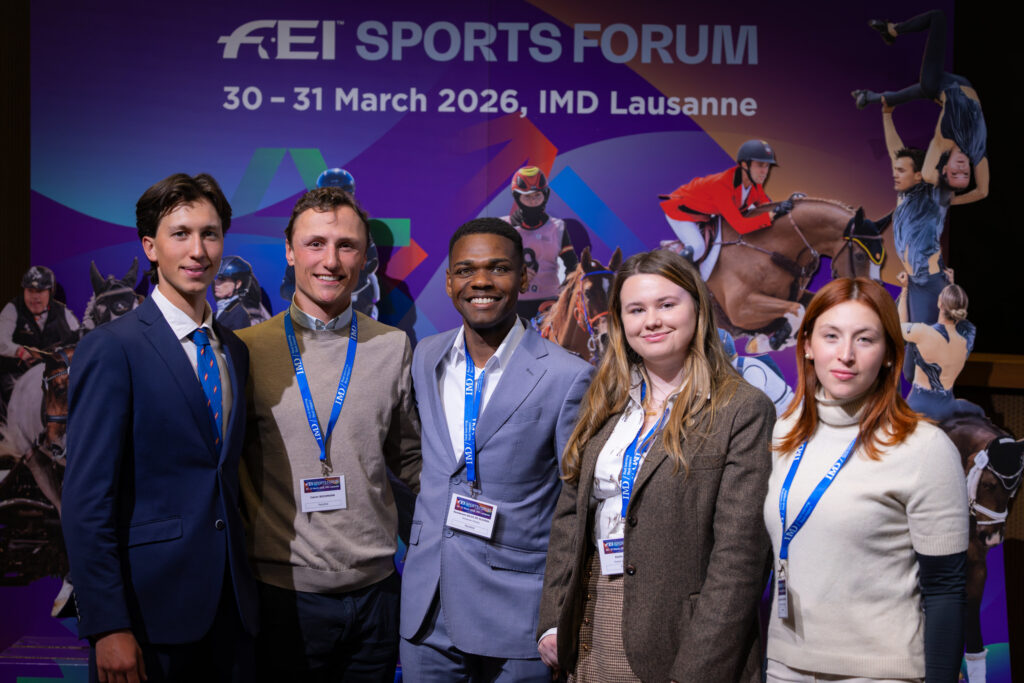
That theme was reinforced during the discussion by FEI President Ingemar de Vos, who addressed the youth riders present in the room directly, stressing that authentic stories cannot be created “from a desk in Lausanne”, but must come from engagement with athletes across the sport. His intervention underlined a recurring theme of the session: that credibility in communication will depend on how closely it reflects lived experience within the sport. De Vos spelt it out in plain language: bring your stories to us, we need you.
Major events are expected to play a key role in the strategy, with the Olympic and Paralympic Games and the FEI World Championships identified as key moments for global visibility. The 2026 World Championships in Aachen were highlighted as a particular opportunity to create significant international content and media focus.
The FEI also signalled a shift towards more data-driven communication, including the development of a clearer understanding of its audience base and the introduction of metrics to track engagement and perception. The concept of “social licence” — how the sport is viewed by the wider public — was identified as an important measure of success, alongside more traditional indicators such as participation and audience reach. As an example, the director revealed a TikTok account run by FEI under a more common name: @myhorseworldclub – My Horse World Club. The few traces of FEI found in the account are if you follow a link in the bio and dig deeper. The account is framed mostly around non-sport-related videos. Vergnol proudly showed an example of an instructional video on how to wash the tail of your horses that has 4.2 million hearts, and according to the presentation, many million views.
While the presentation outlined strategic ambitions, it remained largely high-level, with detailed implementation still to be defined. Notably, the role of traditional media was only marginally addressed within the framework, with the emphasis placed instead on direct-to-audience channels, digital platforms and owned content. This imbalance was reflected in the subsequent discussion, where several questions touched on how established media structures would be integrated into the overall communication approach.
As a way to address concerns from the IDRC and the IJRC concerning negative backlash on social media directed towards athletes, the director disclosed that FEI will utilise technology from a proven vendor during the World Cup Finals in Fort Worth in less than a week. The company Signify provided service for the moderation of commentary fields during the Paris Olympics to protect athletes. More on Signify can be found here. IAEJ has tried to get further information on how it will work, and we will get back on this point.
The Q&A session brought a more practical perspective to the discussion. Several interventions focused on how the strategy would translate into concrete action, particularly in relation to communication channels and stakeholder coordination.
Delegates raised the role of television and wider media visibility alongside the increasing emphasis on digital platforms. While the FEI reiterated that broadcast remains important, the discussion reflected the broader shift towards fragmented, multi-platform consumption.
Carli from the United States Equestrian Federation highlighted the importance of closer collaboration between the FEI and National Federation communication teams, describing the strategy as a “refreshing plan” but pointing to practical gaps in execution. Referring to recent event coverage, she noted that press materials had lacked images of horses and emphasised the need for stronger storytelling support: “We want to help promote your properties… but we need the tools to do that.” Her comments reflected a broader call for clearer coordination and more usable content for media distribution.
Other interventions focused on the speed and effectiveness of communication in response to negative incidents. One delegate noted that “reactions on social media are very fast” and questioned whether the FEI is equipped to respond at the same pace. Vergnol acknowledged that this remains an area for improvement, stating that the organisation is working on clearer processes to classify and respond to issues more quickly and consistently.
Questions also touched on content choices and public perception. A youth rider raised concerns about the use of slow-motion footage of mistakes or incidents without sufficient explanation, pointing to the risk of misinterpretation among non-expert audiences. The response emphasised the need to balance authenticity with context, including more educational content to support understanding of the sport.
Towards the close of the session, Malin Axel Nilsson of the FEI Equine Welfare Advisory Group brought the discussion back to one of the sport’s most sensitive and central topics: how the FEI intends to communicate the extensive welfare work already being carried out. Referring to the Equine Welfare Action Plan and the work undertaken over the past two years, she questioned how its outcomes would be translated into clear and effective communication, and how the current momentum could be maintained.
While the importance of welfare communication had been emphasised throughout the presentation, the response remained general in nature, focusing on the need for clearer messaging and continued efforts rather than outlining specific mechanisms for conveying this work to a wider audience.
Overall, the session highlighted the FEI’s intention to position communication as a central element in the future development of equestrian sport. At the same time, the exchanges in Lausanne made clear that many aspects — from practical delivery to the role of traditional media and the communication of complex issues such as welfare — remain open questions as the strategy moves from concept towards implementation.
Relevant links to official documents and pages:
Summary from FEI
Presentation Marketing and Communications Strategy 2026 – 2030
Panellists biographies
Youtube video Session 4 Marketing and Communication Strategy, the second half is the section for Veterinary matters